01
Isolated platforms
Most systems operate as individual aircraft or vehicles with limited autonomy and no branch-level operational picture.
Manage uncrewed mass as one adaptive, decentralised, multi-domain force — using agentic AI, a unified C5ISR data layer and resilient mesh communications — to remain effective under jamming, GNSS denial, degraded connectivity and attrition.

A short brief on the missing branch — why uncrewed mass without coherence loses tempo, and what an orchestration layer changes.
Uncrewed systems are multiplying faster than the operators who fly them. The bottleneck is no longer access to platforms; it is the ability to coordinate them as one force.
Most systems operate as individual aircraft or vehicles with limited autonomy and no branch-level operational picture.
A single link back to C2 is easy to jam, spoof or attrit. One critical node can become a mission-wide point of failure.
Forces acquire large fleets but still manage them as thousands of disconnected, radio-controlled systems.
One pilot per platform limits the scale, tempo and persistence that uncrewed mass can actually deliver.
The lesson of contemporary conflict is that the side able to manage uncrewed mass as an adaptive, decentralised force — rather than as thousands of individual platforms — wins the tempo.
Hellstorm Systems builds the missing branch: the autonomy, data and orchestration layer that turns heterogeneous systems into one coherent force.
Plans, adapts and tasks the force in natural language, while escalating mission decisions and effects that require human authorisation.
One interoperable operational picture across every sensor and node, with shared mission state, evidence and geospatial context.
Peer-to-peer mesh with SATCOM and fibre-backed relay options so central C2 is not a single point of failure.
An open, model-pluggable control environment connecting edge AI, information-domain capabilities and onboard GIS change detection.

Operators direct mission intent instead of manually flying every platform. The force shares data peer-to-peer, coordinates locally and reconnects opportunistically when central links degrade.
At C2, agentic AI analyses sensor data, builds the common operational picture, develops mission plans, assigns tasks and updates the plan as conditions change. Operators use natural language to direct the formation and review decisions that require authorisation.
Platforms share data directly among themselves, not only with the command centre. Relay nodes maintain paths through mesh, SATCOM or fibre. When the link home degrades, the swarm continues coordinating locally and synchronises when connectivity returns.
An ISTAR node can detect a contact, classify it against mission rules and cue an authorised response across the formation without waiting for a round-trip to C2.
The platform family is representative. The architecture extends to third-party sensors, effectors and vehicles, crewed or uncrewed, across air, land, maritime and space-enabled operations.
EO, thermal, LIDAR, radar, RF and acoustic sensing with onboard detection, classification and georeferencing.
Mesh, SATCOM and fibre-backed communications that preserve command paths and local coordination under disruption.
AI security monitoring, signal analysis and integration with authorised electronic-warfare capabilities.
Configurable signatures and behaviours that support decoy, concealment and adversary-resource diversion missions.
Pluggable response nodes coordinated through the same data, tasking and authorisation architecture.
Ground, maritime and space-supported nodes expand sensing, relay, logistics and operational reach.
Air, ground, maritime and space-enabled nodes share one operational picture and are tasked as one formation. Open, documented interfaces allow partners to add platforms, sensors, models and command systems instead of creating another silo.
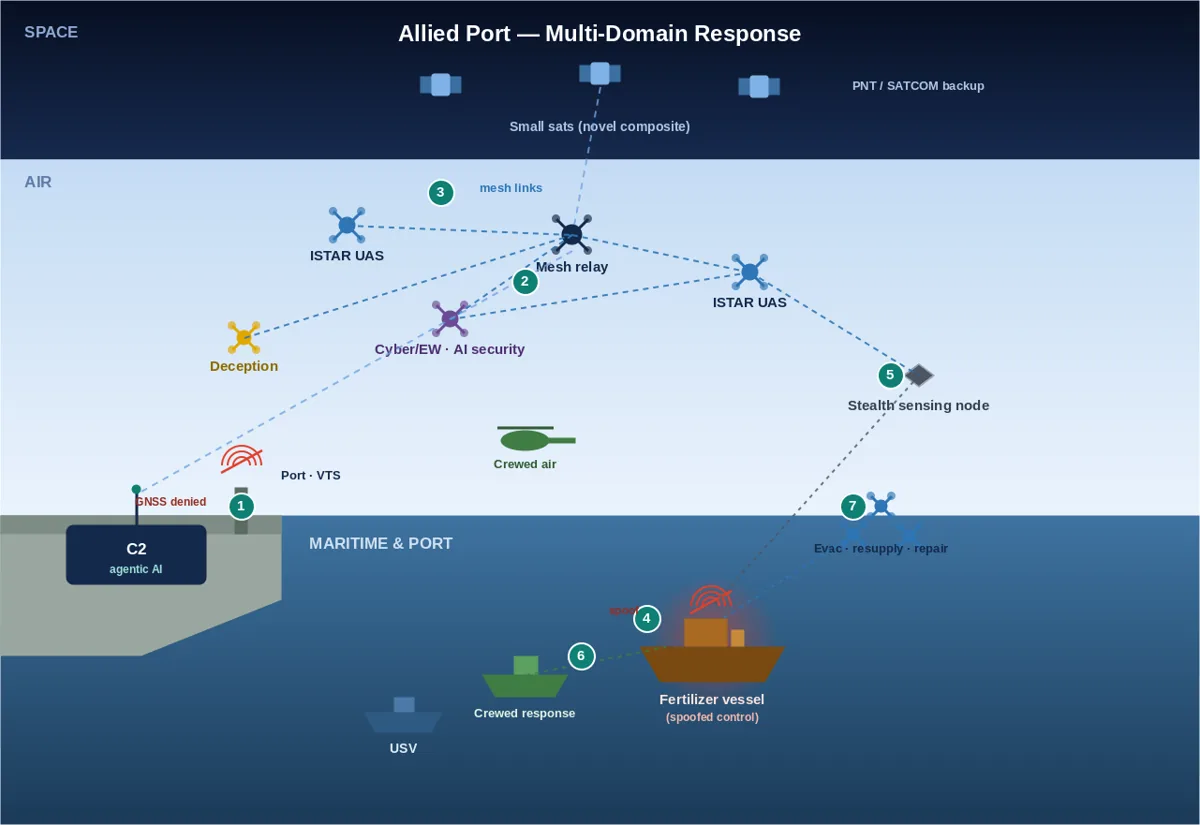
Fuse complementary sensors, reduce false alarms and coordinate the right response across air, land and maritime nodes. The same loop generalises across missions and threat classes.
Warm and cold thermal imagery, EO, radar and other sensors combine to provide earlier warning and stronger evidence.
Edge models distinguish contacts, report class probabilities and uncertainty, and request verification when confidence is insufficient.
The system assigns tracking, inspection, protection or another authorised response to the most suitable node while preserving operator oversight.
The connectivity that makes a distributed force powerful also expands its attack surface. Information assurance, signal awareness and resilient authorisation are core platform capabilities.
Continuous monitoring, anomaly detection and response support to harden nodes, mesh links and C2 against intrusion, spoofing and takeover.
Map and characterise the RF environment, link health and anomalous emissions to support communications resilience and situational awareness.
Dedicated information-domain integration points for authorised defensive, protective and electronic-warfare workflows.
Encryption, zero-trust identity, resilient key management, provenance and assured authorisation are built into the data layer.
Tight, continuous cycles between operators and engineering allow capabilities to be co-developed and improved in days and weeks instead of months and years.
The same autonomy, sensing, communications and data architecture supports defence missions and high-scale civil operations.
The platform sits at the intersection of uncrewed systems, defence autonomy software and dual-use commercial robotics.
Ministries of defence, Allied forces, primes and mission-system integrators seeking scalable autonomy and force protection.
Programs that need command, orchestration, edge intelligence, common data and interoperable mission software.
Agriculture, disaster response, border, maritime and infrastructure operators with similar scale and resilience problems.
A modular commercial model supports initial deployments, recurring software value and mission-specific integration.
Attritable and modular nodes priced for scalable deployment.
Autonomy and orchestration software licensed per deployment or fleet.
HUB, model, analytics, sustainment and capability-update subscriptions.
Model onboarding, customisation, training, support and mission integration.
Agriculture, disaster and infrastructure applications on the same stack.
Our philosophy is that a company should be able to anticipate what is likely to happen — or recognise what has already happened — before it becomes visible or fully understood by others. We combine imagination, creativity, strategic foresight and deep technical understanding to solve complex problems and build practical solutions for the future.
We look beyond the immediate requirement to identify emerging risks, operational shifts and opportunities before they become obvious.
We turn difficult technical and strategic challenges into elegant, effective systems that remain understandable, maintainable and usable in the field.
Our blend of technical expertise, strategic insight and forward-looking vision keeps innovation ambitious while ensuring it is scalable, credible and operationally relevant.
Throughout our work, we have consistently demonstrated an ability to identify elegant, practical and highly effective solutions to complex challenges.
Hellstorm Systems is seeking strategic investors, defence innovation programs, primes, technology partners and operational users.